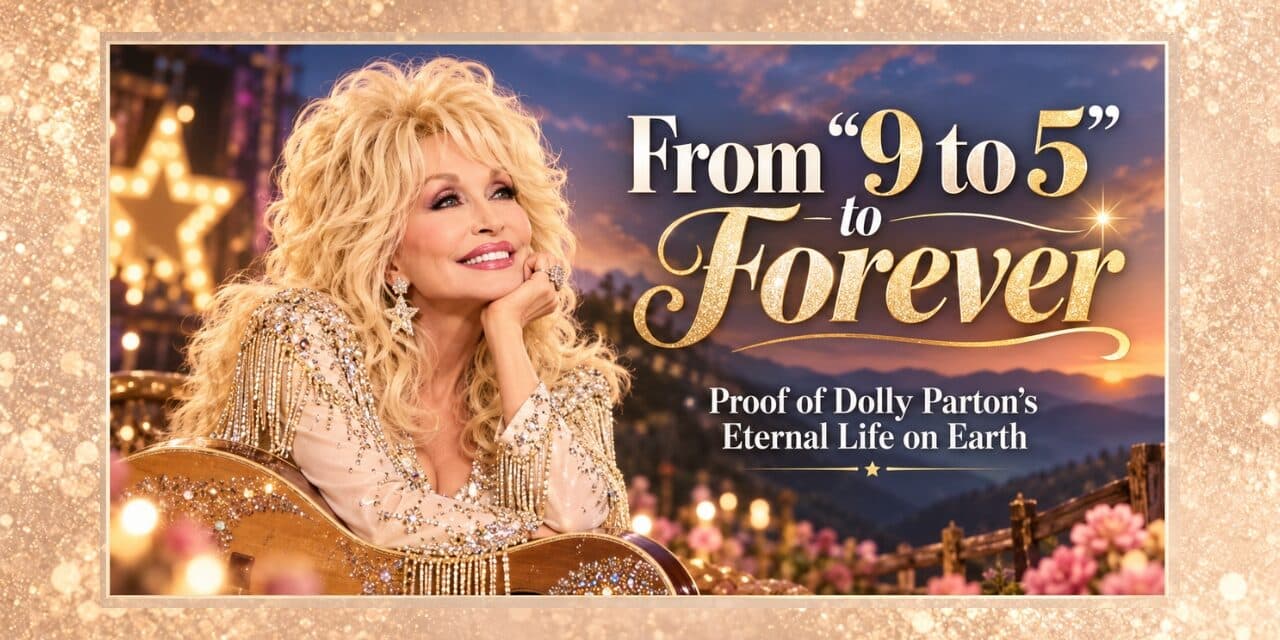
From “9 to 5” to Forever: Proof of Dolly Parton’s Eternal Life on Earth
I had a hunch almost immediately.
When Dolly Parton died peacefully in Nashville on August 25, 2026, at the age of 80, the world responded with the enormous outpouring of grief one would expect for a singular global icon. There were tributes, remembrances, old performances resurfacing, favorite songs being shared and millions of people telling their own Dolly stories.
But then something else started happening.
Dolly wasn’t disappearing from popular culture. She seemed to be multiplying within it.
Her music was surging again. Her movies were being rediscovered in theaters and on streaming platforms. Communities were planning celebrations. Her philanthropy was generating new attention and new participation. Institutions, businesses, artists, public officials and ordinary fans were finding fresh ways to keep her work moving forward. New Dolly-related projects that she had already set in motion were continuing toward completion. In fact, just one day after her death, her team revealed that Dolly had worked until the end and had helped create a project roadmap intended to guide them for decades to come.
That caught my attention.
As a journalist and lifelong observer of entertainment and LGBTQ+ culture, I began wondering whether I was witnessing something larger than the customary burst of attention that follows the death of a beloved celebrity. Dolly Parton appeared to be demonstrating, almost in real time, the difference between having a legacy and having a legacy that remains actively alive.
So I decided to follow my hunch.
I began collaborating with artificial intelligence as a research and monitoring partner, asking it to help me track what I suspected was becoming an exponential expansion of Dolly’s cultural footprint. Together, we watched for new chart activity, theatrical screenings, streaming visibility, philanthropic developments, civic proclamations, celebrations, tributes, new projects and other evidence appearing across the country and around the world. I supplied observations of my own, challenged assumptions, expanded the areas being monitored and made the editorial decisions about what mattered and what did not.
The experiment quickly became part of the story.
Every time I thought I understood the dimensions of what was happening, another piece of evidence appeared.
And then came September 25.
Or, written another way: 9/25.
Across America, the calendar itself has become a Dolly Parton reference—a natural invitation to turn the date into “9 to 5 Day.” Cities, counties and states have begun formally recognizing September 25 in her honor, while libraries, literacy organizations, businesses, performers and fans are using the occasion not simply to remember Dolly, but to continue doing things in her name.
That distinction is at the heart of this story.
I am not attempting to prove that Dolly Parton is immortal in any literal sense. I am making a different argument—one that the evidence accumulating around us makes increasingly difficult to dismiss.
Dolly Parton may have left this Earth, but Dolly Parton has not stopped happening.
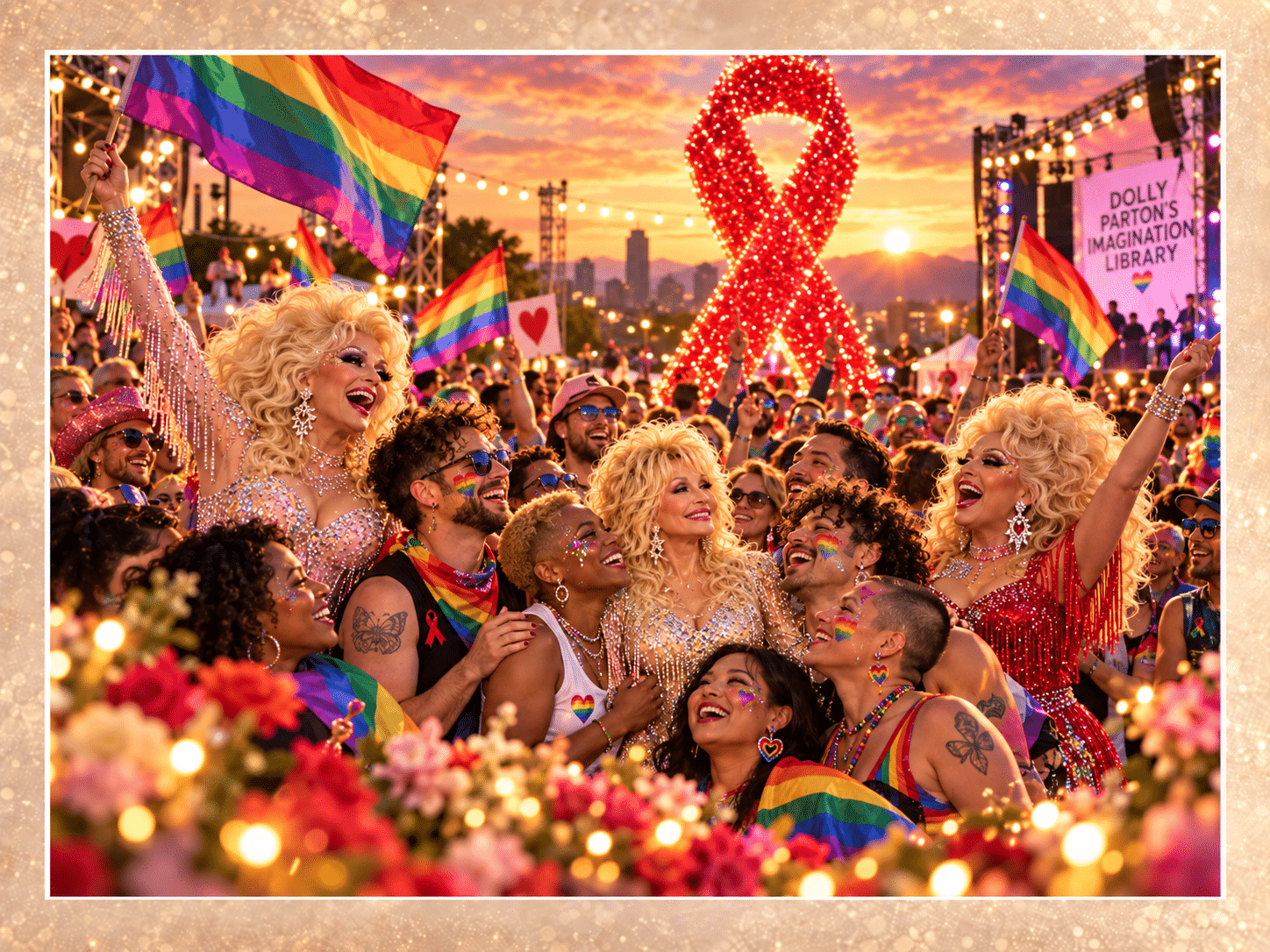
A Love Affair With the LGBTQ+ Community — and a Legacy in the Fight Against HIV/AIDS
For generations of LGBTQ+ people, Dolly Parton was never simply a country music star who happened to have gay fans.
The relationship was deeper than that.
We claimed Dolly, and Dolly very publicly claimed us back.
Long before corporate Pride campaigns became commonplace, Dolly was speaking about gay people with an uncomplicated message of love, dignity and acceptance. She acknowledged her enormous gay following, delighted in seeing Dolly drag queens in her audiences and repeatedly made clear that she had no interest in judging people for who they were or whom they loved.
Her relationship with drag became part of Dolly folklore. She famously told the story of anonymously entering a Dolly Parton look-alike contest populated by drag queens — and losing. In a 2012 interview with ABC News, Dolly recalled exaggerating her own hair, makeup and beauty mark for the competition, only to receive less applause than the people impersonating her.
She loved the joke because she was in on the joke.
That matters. Dolly's flamboyance was never presented as something she needed to defend. The wigs, rhinestones, enormous hair, heels, curves and theatricality were extensions of a woman who decided what she wanted to look like and then became more completely herself. It is not difficult to understand why that philosophy resonated with generations of queer people and drag performers who have also used self-invention as an expression of freedom.
But Dolly's LGBTQ+ connection went far beyond wigs and sequins.
She publicly supported gay rights and defended LGBTQ+ people even when doing so could provoke backlash among portions of her country audience. When threats surrounded gay gatherings associated with Dollywood, Dolly did not retreat from the people being targeted. Her response was characteristically simple: “I love everybody.”
After the 2016 massacre at Orlando's Pulse nightclub, she spoke forcefully about the killing of LGBTQ+ people, saying everyone should be safe and calling for people to love and look after one another more. She also openly embraced transgender people, including those within her own extended family and workforce, and rejected the idea that someone else's identity gave her the right to judge them.
Her art reflected that same instinct.
Dolly wrote and performed Travelin' Thru for the 2005 film Transamerica, whose central character is a transgender woman. The song earned Dolly an Academy Award nomination for Best Original Song. Years later, she joined her goddaughter Miley Cyrus for Rainbowland, a song imagining a world in which people could live freely and peacefully despite their differences.
And during the darkest years of the HIV/AIDS epidemic, Dolly did more than offer encouraging words.
Her own official philanthropic history documents that Sandollar Productions helped bring Common Threads: Stories from the Quilt to audiences in 1989. The documentary about the NAMES Project AIDS Memorial Quilt humanized people who were dying in an era when fear, prejudice and political neglect frequently reduced them to statistics. The film went on to win both an Academy Award and a Peabody Award and was later selected for preservation in the Library of Congress National Film Registry.
Dolly also contributed her recording of You Gotta Be My Baby to the 1994 Red Hot + Country album, part of the groundbreaking Red Hot benefit series raising money and awareness in response to HIV/AIDS. She participated in the country music industry's Break the Silence AIDS-awareness campaign, and in 1996 joined artists including Cher, Cyndi Lauper, Mary J. Blige and TLC for the Commitment to Life IX benefit for AIDS Project Los Angeles.
Those choices carry particular historical significance. Dolly was making them during years when HIV/AIDS was still profoundly stigmatized and when openly embracing gay people could carry very different consequences for a mainstream country artist than it does today.
That history helps explain why the LGBTQ+ response to Dolly's death felt so personal.
In the immediate aftermath, Lambda Legal remembered Dolly for her “bold, consistent support” of LGBTQ+ people and people living with HIV, emphasizing that she offered that support long before doing so was easy or fashionable. LGBTQ+ writers and performers likewise described losing not merely an entertainer they adored, but someone who had repeatedly communicated that they belonged.
And then there are the drag queens.
They are not a footnote to Dolly's legacy. They are part of its living architecture. Every time another performer piles blonde hair toward the ceiling, adds another rhinestone, exaggerates another curve and walks onto a stage as Dolly Parton, the original Dolly appears again — lovingly reconstructed through queer imagination.
That is one of the fascinating things about cultural immortality: sometimes it doesn't reside in a monument.
Sometimes it puts on a wig, steps into the spotlight and lip-syncs “Jolene.”
The Music Didn't Return — It Exploded
The first hard evidence that my hunch was correct came from the music itself.
People were not merely remembering Dolly Parton. They were listening to her in numbers that suddenly made recordings from the 1970s and 1980s behave like current hits.
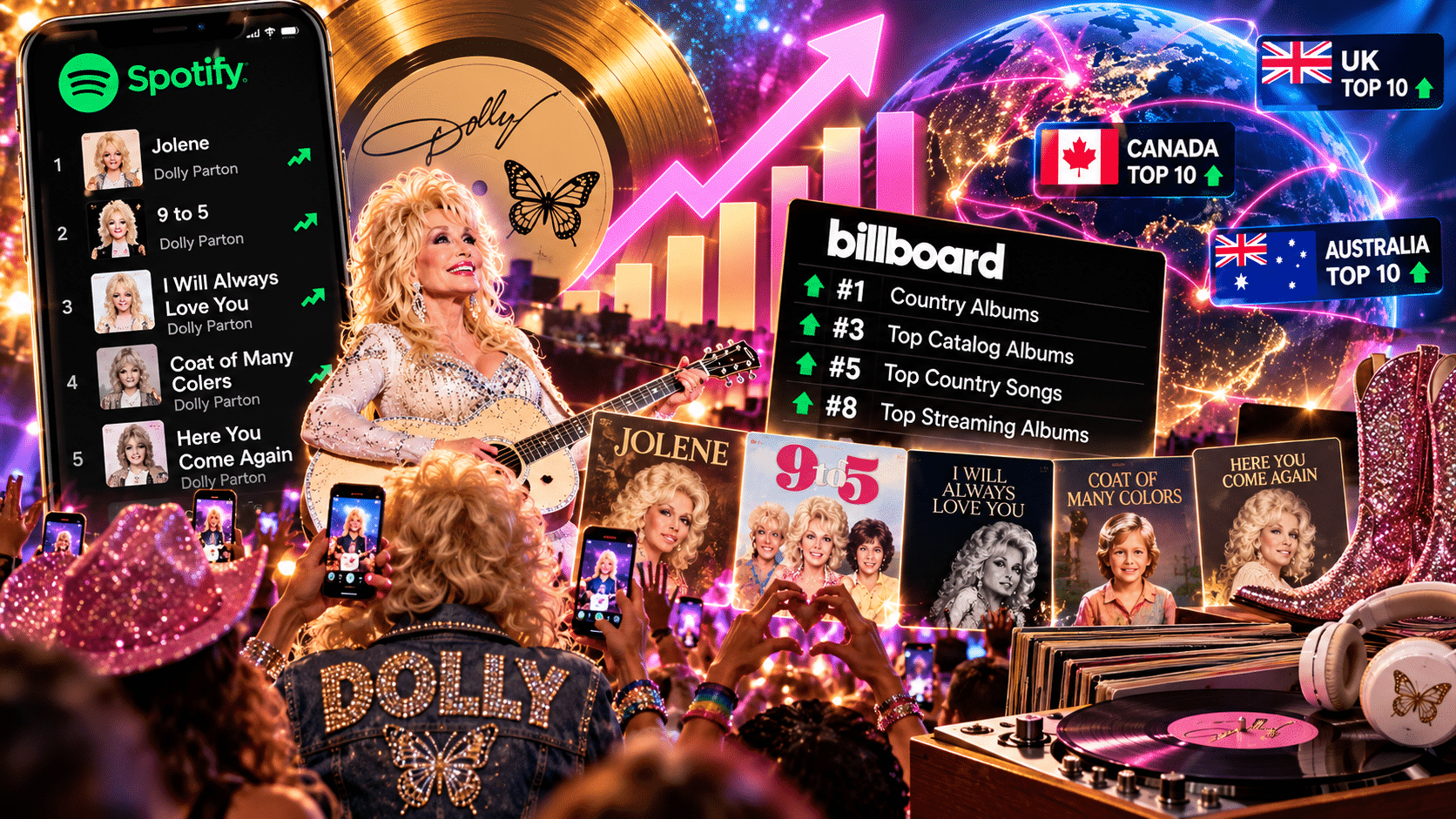
According to Associated Press reporting based on Luminate data, U.S. on-demand audio streams of Dolly's music jumped from approximately 1.2 million on the Monday before her death to 30.5 million on August 25 — an increase of 2,458 percent. By the following day, that number had risen again to 46.3 million.
Globally, the acceleration was just as extraordinary. Her worldwide on-demand audio streams surged to nearly 80 million by August 26, making Dolly Parton the most-streamed artist in the world that day.
Spotify became one of the clearest places to watch that rediscovery happening in real time. Her catalog surged across the platform as listeners returned to the songs that defined her career and, just as importantly, younger listeners encountered them in the same digital environment as the newest releases from today's biggest stars.
Jolene led the charge. The 1973 classic jumped from fewer than 200,000 U.S. streams on the Monday before Dolly's death to more than 4 million in a single day by Wednesday, according to the same AP/Luminate analysis.
Then came 9 to 5, I Will Always Love You, Islands in the Stream with Kenny Rogers, Coat of Many Colors, Here You Come Again and other songs spanning decades of her career. Even newer collaborations benefited from the surge as listeners moved beyond a handful of signature hits and into the larger Dolly catalog.
The scale becomes even clearer when viewed across an entire tracking week. Billboard, citing Luminate, reported that Dolly's catalog generated 116.7 million U.S. on-demand streams during the August 21–27 tracking period, compared with 9.4 million the previous week — a 1,143 percent increase.
Radio audience impressions rose 1,632 percent. Equivalent album units increased more than 1,400 percent. Downloads soared by more than 8,000 percent.
And the charts began rewriting Dolly's history.
In the United States, Jolene returned to the Billboard Hot 100 at No. 16, giving the song a new peak more than half a century after its original release. I Will Always Love You entered the chart at No. 27, and the compilation Ultimate Dolly Parton returned to the Billboard 200 at No. 5.
But some of the most remarkable developments were happening across the Atlantic.
In the United Kingdom, the Official Charts Company reported that Jolene initially returned at No. 9 following a 364 percent week-over-week increase, while 9 to 5 surged 350 percent to No. 12.
That No. 12 showing alone was historic: it marked the first time 9 to 5 had ever reached the UK Top 40. The song's original British peak, back in 1981, had been only No. 47.
And then it climbed even higher.
By early September, Dolly accomplished something she had never done while alive: she placed three songs simultaneously inside the UK Top 10. 9 to 5 rose to No. 5, Jolene climbed to No. 6, and Islands in the Stream reached No. 9.
For 9 to 5, No. 5 became a new career high in Britain. For Jolene, the resurgence produced another extraordinary late-career chapter. The Official Charts data also shows 9 to 5 reaching No. 1 on the UK Singles Chart Update and No. 6 on the country's streaming chart during this posthumous run.
There is something profoundly Dolly about all of this.
A song about a predatory woman named Jolene, written more than five decades ago, suddenly sits alongside contemporary pop music in streaming rankings. A workplace anthem released in 1980 achieves its highest British chart position in 2026. A duet with Kenny Rogers finds another generation. A song Dolly wrote before Whitney Houston transformed it into one of the biggest recordings in history becomes part of Dolly's own renewed chart story.
These are not songs being preserved behind glass.
They are being played in cars, added to Spotify playlists, streamed through phones, rediscovered through social media, bought again, downloaded again and introduced to listeners who were not alive when many of them were first released.
That distinction became increasingly important to me as I tracked this story.
A legacy can be measured by how much work survives.
But a living legacy can be measured by how much of that work suddenly starts moving again.
The Movies Came Back, Too — On Screens Large and Small
The music resurgence would have been remarkable enough on its own.
But Dolly Parton's film career began moving again at the same time.
Movies that had long since become part of the cultural memory were suddenly being programmed again, streamed again, sold out again and, in some cases, turned into fundraising vehicles for the very causes Dolly cared about most.
That is where this story became especially interesting to me.
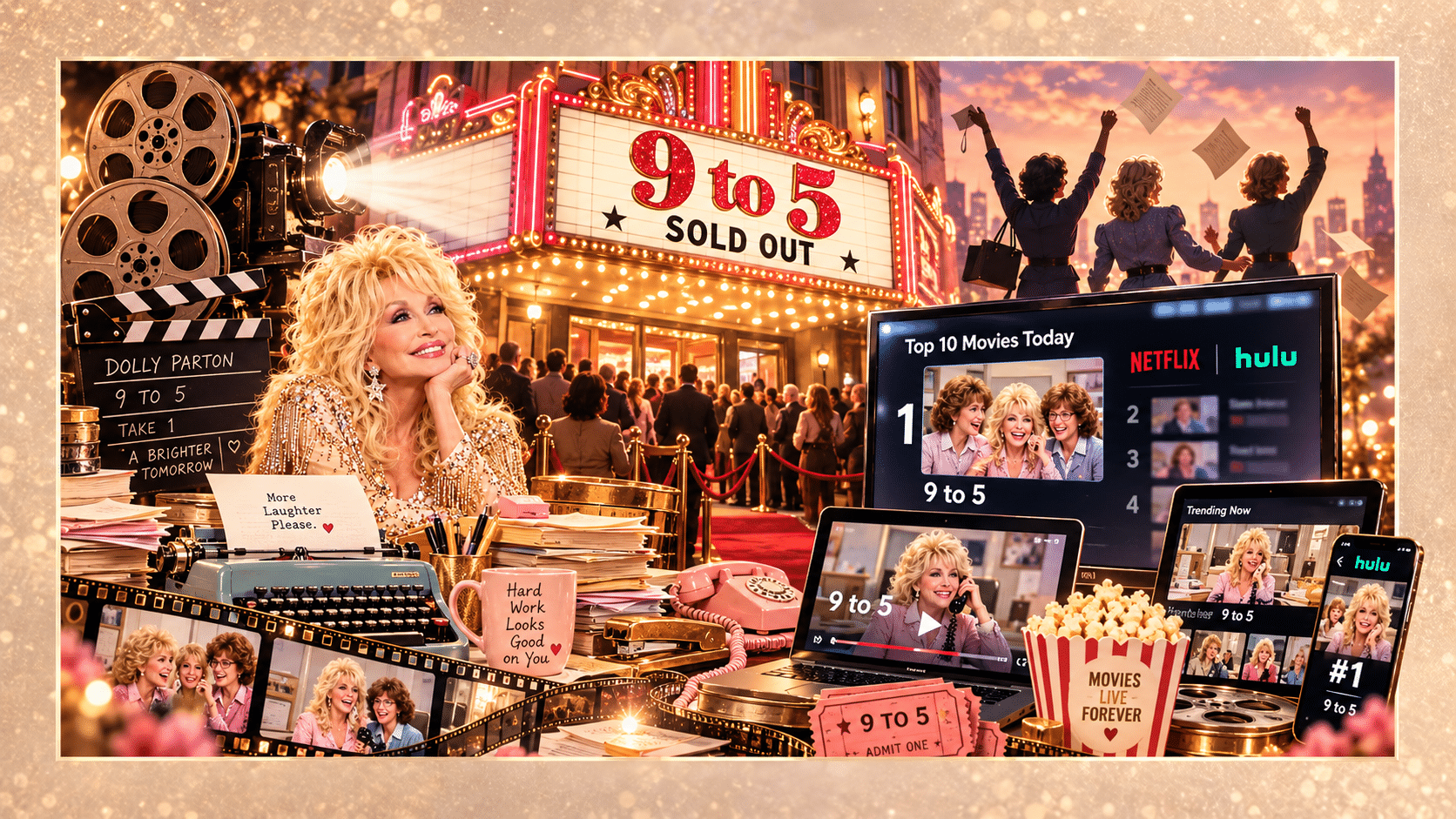
The 1980 comedy 9 to 5 — Dolly's feature-film debut alongside Jane Fonda and Lily Tomlin — began appearing simultaneously across theatrical and streaming platforms. On Hulu, the film reached No. 1 among movies in the United States on September 2, according to FlixPatrol's daily streaming rankings.
The symbolism was almost too perfect.
A movie released 46 years earlier — built around a song that was itself becoming newly relevant again — was sitting at the top of a contemporary streaming chart while September 25 was simultaneously emerging as 9 to 5 Day.
And audiences were not only watching Dolly from their couches.
Movie theaters began putting her back on the big screen.
Regal initially brought Steel Magnolias and The Best Little Whorehouse in Texas back to 12 Tennessee theaters as a tribute. The response was so strong that the screenings raised enough money to provide more than 7,500 Imagination Library books — approximately a year's worth of books for more than 600 Tennessee children.
So Regal expanded the tribute nationwide.
From September 4 through 9, more than 200 Regal theaters across 35 states and Washington, D.C. screened Steel Magnolias and The Best Little Whorehouse in Texas, with 100 percent of the proceeds going to The Dollywood Foundation to support Dolly Parton's Imagination Library.
And because this is Dolly, even the ticket price became part of the tribute:
$9.25.
Nine to five.
Other theater chains joined in. Harkins Theatres programmed special tribute screenings of Steel Magnolias and The Best Little Whorehouse in Texas, with proceeds benefiting the Imagination Library. Independent theaters and community cinemas began programming Dolly films of their own.
The revival has continued into 9 to 5 Day itself.
In New York City, IFC Center opens a special run of 9 to 5 on September 25 as part of its appropriately titled series, Dolly Parton: IFC Center Will Always Love You.
Elsewhere, theaters are using screenings of 9 to 5 specifically to raise money for local Imagination Library programs. In Rutland, Vermont, for example, the historic Paramount Theatre is screening the film September 29, with ticket proceeds supporting the local chapter that has already mailed nearly 28,000 free books to area children.
And the revival is not ending in September.
Disney has scheduled a nationwide theatrical re-release of 9 to 5 beginning October 9, with net proceeds from every U.S. ticket purchase going to The Dollywood Foundation in support of the Imagination Library.
That is where the film revival becomes more than nostalgia.
Watching Dolly's movies now can literally help put books into children's hands.
Her screen work is generating fresh audiences, fresh ticket sales, fresh streaming activity and fresh philanthropic impact at the same time.
And the films themselves reveal just how broad Dolly's cinematic persona became: Doralee Rhodes fighting workplace sexism in 9 to 5; Miss Mona running the Chicken Ranch in The Best Little Whorehouse in Texas; Truvy Jones dispensing hairspray and wisdom in Steel Magnolias.
These characters did not disappear when their original theatrical runs ended.
They entered the culture.
And now the culture is putting them back on the screen.
The Imagination Library: A Legacy Arriving in Millions of Mailboxes
If Dolly Parton's music and movies demonstrate how an artist can remain culturally alive, the Imagination Library demonstrates something even more extraordinary.
Her legacy is still arriving in the mail.
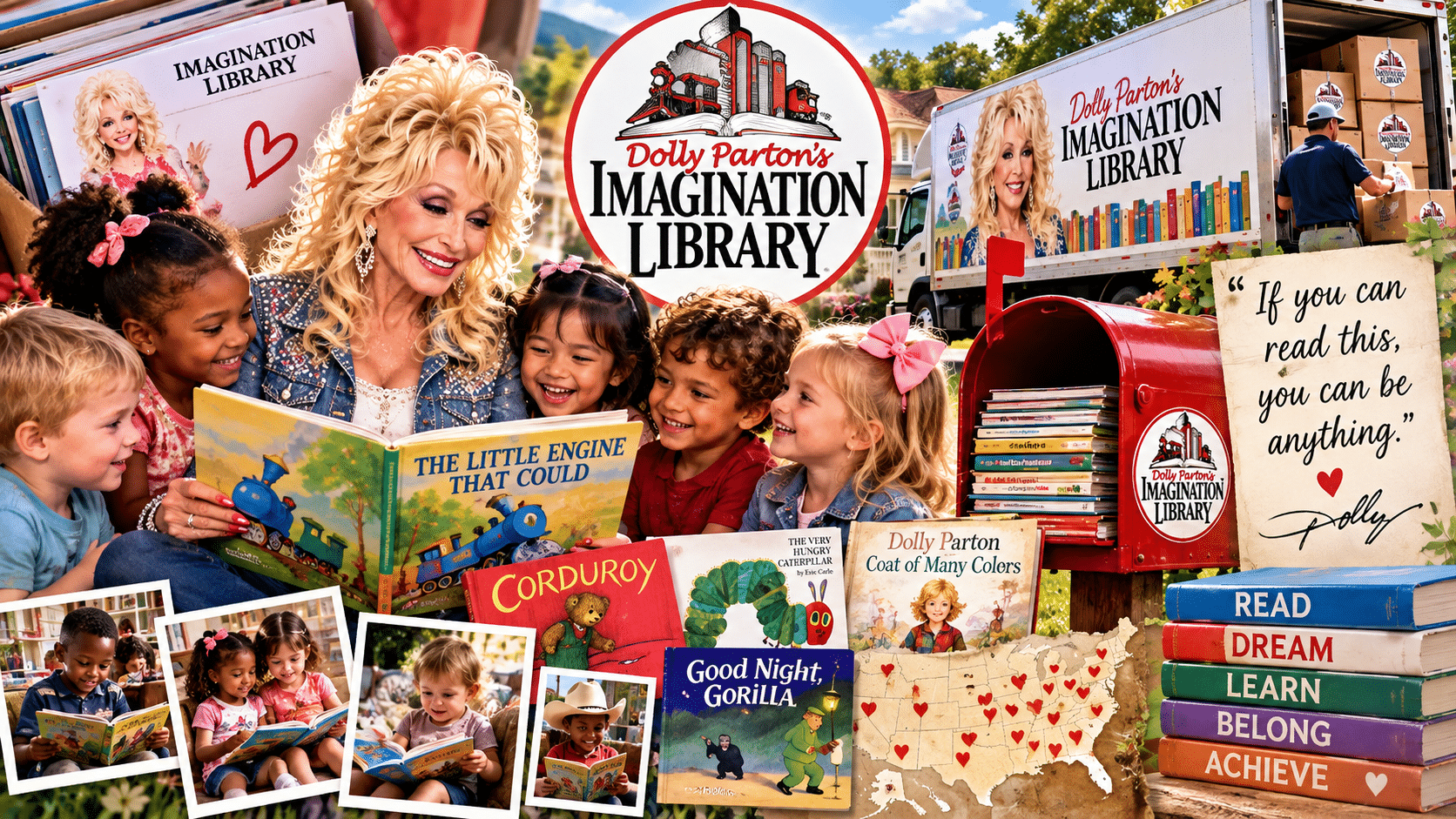
Every month, millions of children open their mailboxes and find a book addressed directly to them — a gift from a program Dolly created more than three decades ago because she understood what literacy could mean to a child's future.
The story began close to home.
Dolly launched Dolly Parton's Imagination Library in 1995 for preschool children in Sevier County, Tennessee, where she grew up. The inspiration was deeply personal: her father, Robert Lee Parton, could not read or write. Dolly has often described the Imagination Library as one of the accomplishments of which she was proudest because of what it meant to him.
The original idea was beautifully simple.
Enroll a child, and from birth until age five, that child receives a carefully selected, age-appropriate book every month — mailed directly to the home and provided free to the family.
No test. No requirement that the parents prove financial need. No distinction between rich children and poor children.
Just books.
And then the idea grew.
What began in Dolly's home county expanded nationally and then internationally. Today, the Imagination Library operates through partnerships in the United States, Canada, the United Kingdom, Australia and the Republic of Ireland. By June 2026, Dolly's organization reported that more than 325 million books had been gifted since the program began, with more than 3.5 million additional books being mailed every month.
Think about that monthly number for a moment.
More than 3.5 million books.
Not downloads. Not views. Not streams.
Physical books traveling into homes and into the hands of children.
The books are selected for specific developmental stages, and in the United States the program now includes bilingual English-Spanish selections. A child's first book is a customized edition of The Little Engine That Could; the final book arrives during the month the child turns five. The program's 2026 selections include titles ranging from classics such as Llama Llama Red Pajama and Eric Carle books to newly selected contemporary children's literature.
That physical ritual matters.
The child's own name appears on the package. The book arrives at the child's home. The experience communicates, month after month, that reading belongs to them.
And this is not philanthropy frozen in Dolly's lifetime.
It continues expanding.
In Canada, the Imagination Library celebrated its 20th anniversary in 2026 after surpassing 5 million books gifted to Canadian children. In California, where I live, the statewide program has expanded across dozens of counties, mailing millions of books since its 2023 expansion while working toward availability for every child under five in every ZIP code. The California program reported nearly 172,000 participating children as of March 2026.
The scale alone would qualify the Imagination Library as one of Dolly's defining achievements.
But something else happened after her death.
People began using virtually every corner of the Dolly revival to feed the program she left behind.
Movie theaters donated proceeds from Dolly screenings. Communities tied 9 to 5 Day observances to local literacy efforts. Libraries created Dolly-themed programming. Fans made donations. Businesses used celebrations of her life to direct attention back toward children's books.
That is why the theatrical revival I described earlier is about much more than box-office nostalgia.
A person can buy a ticket to see Dolly Parton in a movie made decades ago, and that ticket can help finance a book that lands in the mailbox of a child Dolly never met.
The movie creates the donation.
The donation creates the book.
The book reaches the child.
And perhaps the child discovers a dream.
Dolly once described books as seeds from which children's dreams can grow. That idea has become an extraordinary mechanism for extending her influence into generations that will know her first not from a concert stage or movie screen, but from something that arrived with their name printed on it.
Long after the last applause from any performance fades, those books will still be sitting on shelves.
And somewhere tonight, another child is being read a bedtime story because Dolly Parton decided that child should have one.
9/25 Became More Than a Date — It Became Dolly Parton Day
Then came one of the most fascinating developments of all.
September 25 — written numerically as 9/25 — began transforming into a civic celebration of Dolly Parton herself.
The connection to 9 to 5 is irresistible, of course. But what has happened around that date goes far beyond a clever numerical tribute.
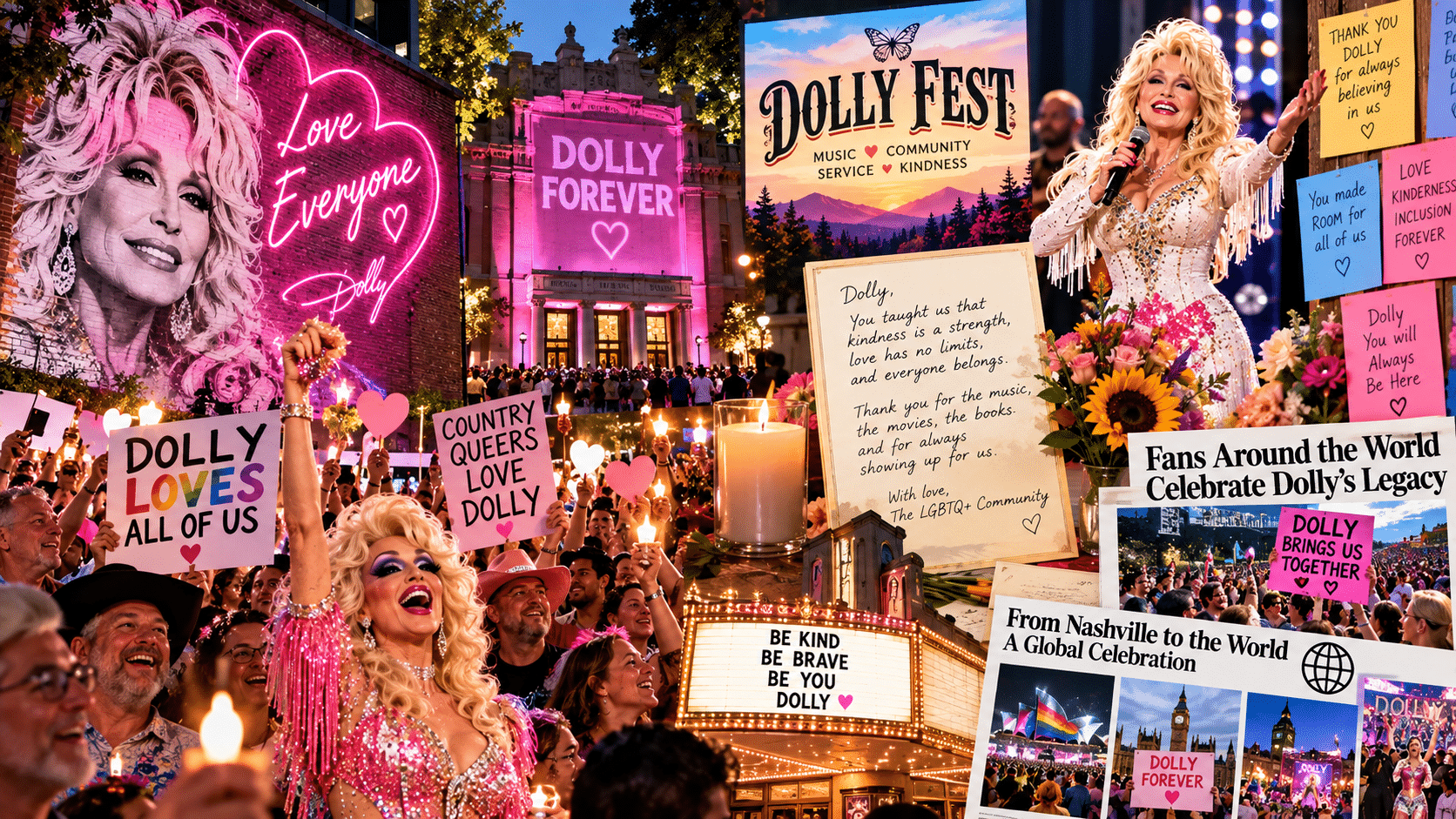
Governments, libraries, businesses, nonprofits and community organizations across the country have begun using 9/25 as an annual occasion to celebrate Dolly's music, philanthropy, kindness and belief in literacy.
Here in California, that recognition became official statewide.
On September 20, Governor Gavin Newsom signed SB 931, establishing September 25 as Dolly Parton Day in California. The legislation specifically chose 9/25 in honor of Dolly's iconic song 9 to 5.
California was hardly alone.
According to Good Morning America, municipalities and counties across the country have issued their own proclamations, including Nashville, Sevierville, Pigeon Forge, Gatlinburg and Pittman Center in Tennessee; Manhattan in New York; Portland, Oregon; Hays County and Montgomery County in Texas; and other communities joining the expanding map of Dolly observances.
Seattle has officially proclaimed September 25 Dolly Parton Day, pairing the recognition with children's literacy programming and a Dolly-themed story hour in partnership with the Imagination Library and Seattle Public Library. The city is also celebrating with a Dolly-inspired silent disco and a screening of 9 to 5. Seattle's proclamation specifically connects the celebration to Dolly's commitment to children's literacy.
King County, Washington, went even further, formally declaring the date Dolly Parton 9 to 5 Day while celebrating the restoration of Imagination Library service in the county. The event includes children's story time, free books and public-health outreach. The county proclamation explicitly links Dolly's legacy to literacy, childhood development and public service.
Fort Smith, Arkansas, has also formally proclaimed September 25 as Dolly Parton's 9 to 5 Day, encouraging residents to celebrate both her entertainment career and her philanthropic work.
Portland, Oregon, turned its observance into something closer to a citywide festival.
After officially proclaiming September 25 Dolly Parton Day, Portland announced participation from restaurants, bars, music venues and community groups throughout the city. Businesses are offering Dolly-inspired food and drinks, live music, costumes, charitable giving and literacy fundraisers.
One Portland venue is hosting a Dolly-themed musical performance at Darcelle XV Plaza — an especially appropriate location given Dolly's long relationship with drag culture and LGBTQ+ audiences.
Nashville is illuminating the city in pink and covering parts of downtown with Dolly imagery. Garth Brooks and Trisha Yearwood are donating proceeds from their Friends in Low Places Bar & Honky-Tonk to the Nashville Public Library and the Imagination Library.
San Francisco is holding a daytime celebration in Union Square.
In New Orleans, the Krewe of Dolly is leading a parade through the French Quarter toward the New Orleans Jazz Museum.
And nearly everywhere these celebrations appear, the same pattern repeats:
Music becomes community.
Community becomes generosity.
Generosity becomes books, literacy programs, donations and public service.
That is what makes 9/25 so much more interesting to me than a commemorative date on a calendar.
It is becoming a mechanism through which people actively perform Dolly's values.
They wear the rhinestones.
They play the songs.
They watch the movies.
They read to children.
They raise money.
They gather together.
And year by year, if this tradition continues spreading, something remarkable may happen:
Dolly Parton will not merely be remembered every September 25. She will keep giving people something to do.
Dolly Planned for the Future — and the Future Is Already Arriving
At some point in following all of this, I realized I was not simply watching a legacy expand after Dolly Parton's death.
I was watching a plan unfold.
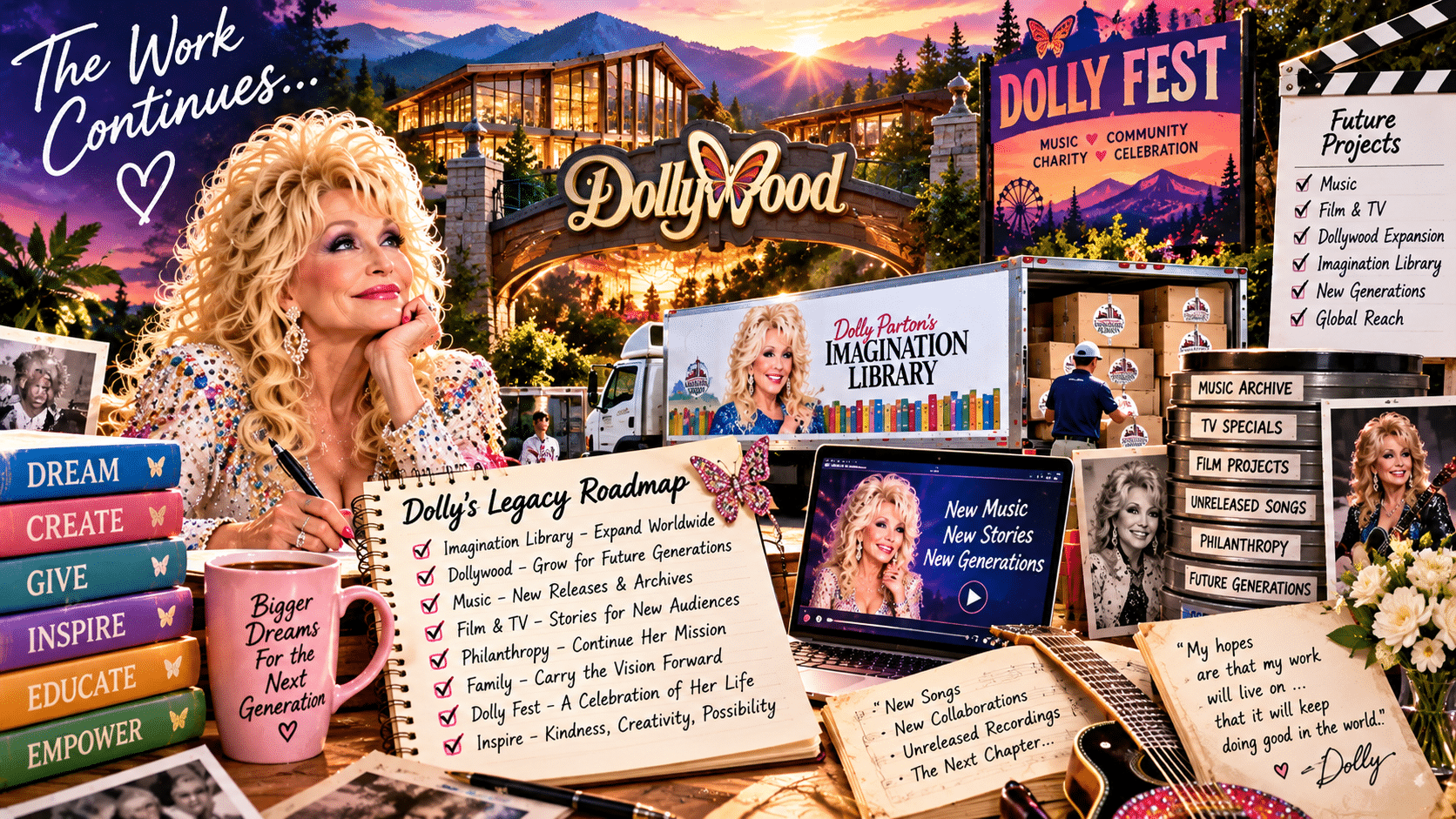
Just one day after she died, Dolly's longtime team made something extraordinary clear: she had been working until the end and had deliberately created a roadmap intended to guide projects for decades to come.
Her longtime manager, Danny Nozell, said Dolly had spent several years working with a handpicked team to make sure dreams she had not yet personally completed could still become reality.
That may be one of the most important facts in this entire story.
Because it means that many of the Dolly projects appearing now are not opportunistic attempts to manufacture something after her death.
They were already hers.
She conceived them, approved them, worked on them and, in many cases, personally placed her stamp on them before she died.
The list is almost startling in its scope.
In September alone, Dolly's Tennessean Travel Stops began rolling out special activities; Dolly Parton's SongTeller Hotel began welcoming guests; and a line of collectible Dolly Dolls launched online.
On September 29, Nashville is scheduled to see the grand opening of Dolly's Life of Many Colors Museum, alongside the formal opening celebration for the SongTeller Hotel. That same date brings the online launch of Dolly's Cup of Ambition Coffee, with a broader retail rollout planned for spring 2027.
And those are only the projects arriving immediately.
According to Dolly's official team, Dolly On The Holly is planned for the 2026 holiday season. DOLLY: A True Original Musical is scheduled to begin Broadway previews December 7, 2026, before opening January 19, 2027. A Kendra Scott x Dolly 9 to 5 Collection is planned for January 2027, followed by Dolly-branded dog treats and home décor later in the year.
And beyond those announced launches sits an even larger development pipeline.
Her team says future projects include a Dolly avatar show, a documentary about the Dolly musical, a Dolly Parton biopic, a docuseries, a scripted television series, a Billy the Kid animated project and additional music, products, books, experiences and campaigns still to be revealed.
Some of the first posthumous launches have already demonstrated just how powerful that demand remains.
The first limited-edition Dolly Dolls, created with Dolly's involvement before her death, sold out almost immediately, with additional releases already planned.
Meanwhile, Dollywood is confronting a different question: how do you preserve the spirit of the woman who called herself its “Dreamer-in-Chief” without freezing the park in time?
Dollywood Parks & Resorts has announced new experiences and installations designed to honor Dolly's life, faith, influence and connection to the Great Smoky Mountains. Park leadership says years of conversations with Dolly helped establish how she wanted her vision carried forward.
That vision was never about building a mausoleum.
Dollywood itself emphasized that after her death, saying Dolly wanted the park to remain a place of joy, hope and togetherness — a place where people would honor her not with silence, but with laughter, music and shared dreams.
Even on the day after her death, the park stayed open.
The show, quite literally, went on.
And then there is DOLLYFEST.
Rather than organizing a conventional public memorial, Dolly's family and team have announced DOLLYFEST: The Celebration of A Lifetime, a star-studded two-day festival planned for 2027 — another indication that the instinct surrounding Dolly is not simply to mourn her, but to gather, perform, celebrate and keep the energy moving forward.
The more I watched all of this develop, the more the distinction became impossible to miss.
Most artists leave behind a body of work.
Dolly Parton left behind a body of work and a queue.
There are songs still to hear.
Stories still to tell.
Businesses still to open.
Productions still to premiere.
Books still to mail.
And dreams she intentionally handed to other people with instructions to keep going.
Dolly Parton did not merely leave a legacy behind. She left work in progress.
What Does It Mean for a Life to Continue?
After weeks of watching all of this unfold, I keep coming back to one question:
What does it actually mean for someone to live forever?
Not biologically, of course.
Dolly Parton died.
There is no sentimentality powerful enough to change that fact, and there shouldn't be.
But death and disappearance are not the same thing.
That distinction has become the central revelation of this entire reporting experiment for me.
I began monitoring Dolly's legacy because I had a hunch that something unusual was happening. I suspected that the response to her death was expanding rather than contracting — that instead of moving through the familiar cycle of grief, tribute and gradual retreat from public attention, Dolly's cultural presence was somehow accelerating.
The evidence kept arriving.
Songs written half a century ago began climbing contemporary charts.
Millions of people streamed her music in extraordinary numbers.
Movies returned to theaters and streaming charts.
Ticket sales became donations.
Donations became children's books.
Those books continued arriving in millions of homes.
Cities, counties and states began turning 9/25 into a civic holiday.
Drag performers continued transforming themselves into Dolly.
LGBTQ+ people continued telling stories about what her acceptance had meant to them.
Children too young ever to have seen Dolly perform began encountering her through books she made possible.
And projects she personally helped create continued moving toward stages, screens, businesses, museums and audiences she would never physically see.
At a certain point, the pattern became impossible for me to regard as ordinary nostalgia.
Nostalgia looks backward.
This is moving forward.
That may be the difference between being remembered and remaining culturally alive.
A remembered person survives in photographs, recordings, monuments and stories.
A culturally living person continues to cause things to happen.
Dolly is still causing things to happen.
Someone hears Jolene for the first time.
Someone watches 9 to 5 and discovers that its rage about workplace inequality still feels startlingly contemporary.
Someone puts on a blonde wig and rhinestones and becomes Dolly for three minutes on a drag stage.
Someone receives a book in the mail.
Someone reads that book aloud to a child.
Someone attends a festival.
Someone makes a donation.
Someone decides kindness is strength rather than weakness.
Someone who feels different hears Dolly's lifelong message and understands that being different does not disqualify them from belonging.
Each of those moments extends the life of an idea.
And Dolly left behind an astonishing number of ideas.
Work hard.
Dream bigger than your circumstances.
Read.
Give.
Laugh at yourself.
Wear the rhinestones.
Love people.
Do not confuse kindness with surrender.
Do not allow somebody else's discomfort to determine who you are allowed to be.
And when success finally arrives, turn around and use some of it to help somebody else climb.
That may ultimately be why Dolly Parton occupies such an unusual place in American culture.
Her celebrity was enormous, but celebrity alone does not produce what we are witnessing now.
Fame can preserve an image.
Dolly built systems.
She built songs people could continue singing.
Characters people could continue watching.
A theme park people could continue visiting.
A literacy program capable of continuing without her.
A relationship with LGBTQ+ audiences grounded in decades of mutual affection.
A business and creative infrastructure designed to keep producing.
And, perhaps most importantly, she cultivated an emotional relationship with millions of people who feel that they personally understand something about who Dolly was.
That relationship cannot be charted as easily as streams, ticket sales or books mailed.
But it may be the most powerful metric of all.
When I chose the headline From “9 to 5” to Forever, I was playing with words.
After tracking this story, I am not sure it feels like wordplay anymore.
Dolly Parton's body of work is being consumed.
Her philanthropy is functioning.
Her projects are advancing.
Her values are being enacted.
Her image is being recreated.
Her stories are being retold.
Her songs are being sung by people who were born decades after she wrote them.
And tomorrow, somebody who has never heard of Dolly Parton will encounter her for the first time.
That is not immortality in the biological sense.
It may be something more achievable — and, in its own way, more beautiful.
It is the ability of one human life to continue creating consequences after that life has ended.
By that measure, my hunch was right.
Dolly Parton is gone. Dolly Parton is still here. And if what we are witnessing continues, Dolly Parton is going to be here for a very, very long time.
And Dolly, I will always love YOU.
— Nicholas Snow
Late Breaking on 9 to 5 Day
Late Breaking: 9 to 5 Day Is Underway
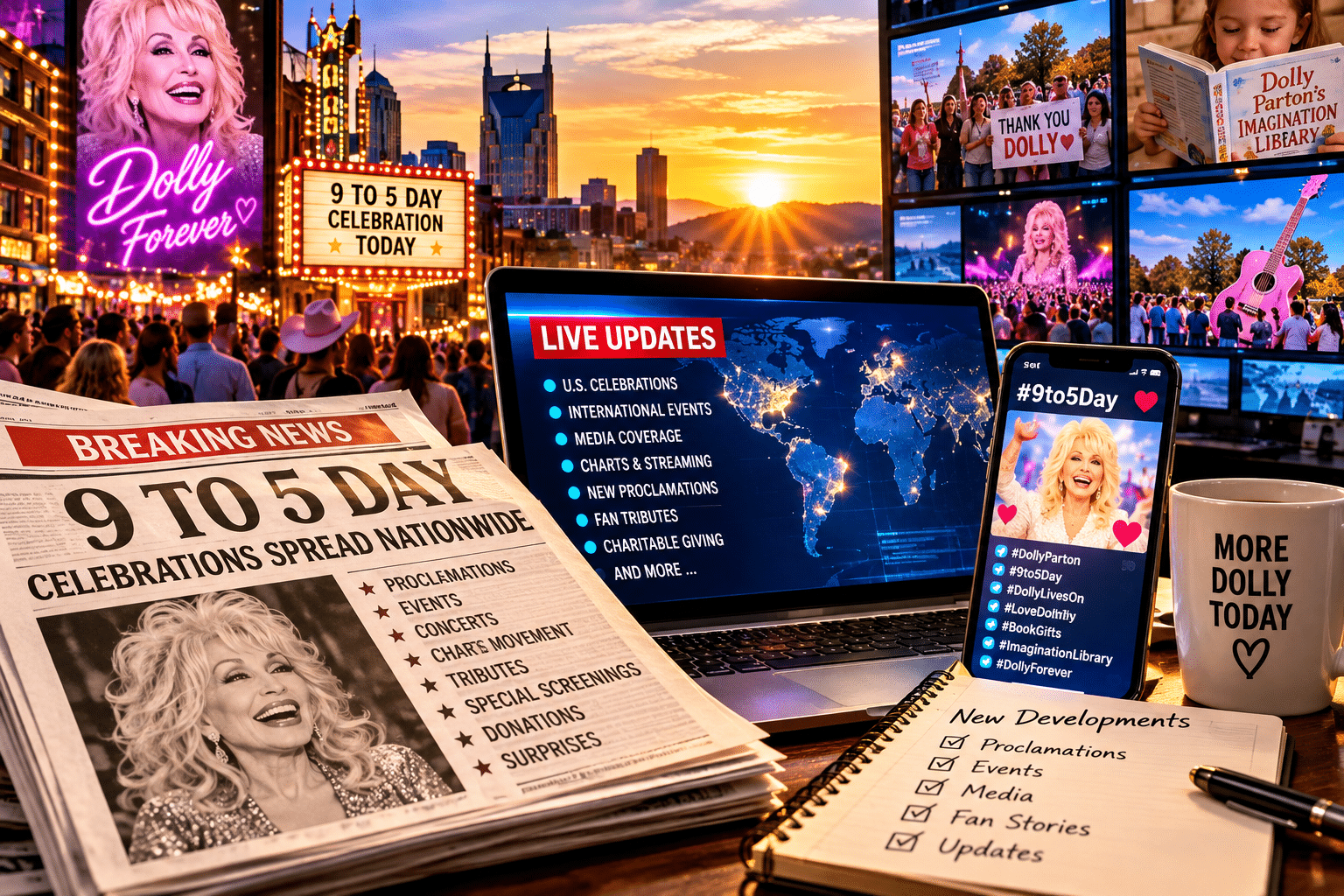
September 25, 2026 — Morning update: The date at the heart of this story has arrived. What began as a play on the title of Dolly Parton's song is taking shape across television, theaters, civic calendars and children's literacy programs.
National television has joined the celebration. Good Morning America broadcast live from Nashville this morning, bringing the city's Dolly Day observance to a national audience. ABC is also reporting that dozens of municipalities are recognizing September 25, while California has established it as an annual Dolly Parton Day.
The movies are back in theaters today. New York's IFC Center begins its weeklong Dolly Parton tribute on September 25 with 9 to 5, Steel Magnolias and The Best Little Whorehouse in Texas. In Nashville, the Country Music Hall of Fame and Museum has scheduled a free screening of 9 to 5 for this evening. These are fresh examples of the film revival documented earlier in this feature.
Her literacy work is part of the day, too. Dolly Parton's Imagination Library has designated September 25 Give Like Dolly Day. In Washington, the King County Council has proclaimed today “Dolly Parton 9 to 5 Day” as Imagination Library service is being restored in the county through a new partnership. The tribute is helping carry her book-giving mission forward.
And the day is still unfolding. Nashville's music and fireworks are ahead. Across the country, audiences will gather for screenings, children will receive books, and people will find their own ways to honor Dolly.
That is the story of 9 to 5 Day in motion. A song became a date. The date became a celebration. And the celebration is becoming another way for Dolly Parton to keep making a difference in people's lives.
My work is created through a human-led process in which I develop all story ideas, conduct all reporting, shape the narrative voice, and retain full editorial control. I also use advanced AI tools as part of my workflow—for research support, organizational assistance, drafting, and editing. These tools help streamline production, but the creative direction, original insights, lived experience, and final decisions remain entirely my own. All content ultimately reflects my voice, perspective, and professional standards as a journalist, storyteller, and media creator.